Skip to content
Road freight removals from the UK to Europe, door to door Speak to a move consultant · 07749 924755
HALOINTERNATIONAL RELOCATIONS

Moving to Europe by road

Europe is the one destination where your belongings never go into a container, never sit in a port, and never change hands. One crew loads the vehicle at your door in Britain and unloads it at your door in France, Spain or Poland, usually within the week.

Last reviewed:

The route at a glance

Collected from
Any UK address
Crossing via
Eurotunnel, Dover–Calais, North Sea
Typical transit
2–10 days door to door
Departures
Weekly to the main routes
Book by
3–4 weeks before you move
Since 2021Every UK–EU move now needs a customs declaration
6 monthsOwnership that qualifies your goods for relief
12 monthsThe window to import after you establish residence
One crewThe people who load are the people who deliver

Brexit changed the paperwork, not the lorry

The transport side of a European move is the same as it was: a removal vehicle, a ferry or the tunnel, and a drive. What changed in 2021 is that the United Kingdom became a third country for customs purposes. Every household move between Britain and the EU now needs an export declaration on one side and an import declaration on the other, plus evidence that the goods are yours and that you are genuinely moving your home.

None of it is difficult, and the relief that makes your belongings duty and VAT free is generous. But it is administrative, it has deadlines, and the documents differ by country. That is now the main thing a European mover is actually being paid for.

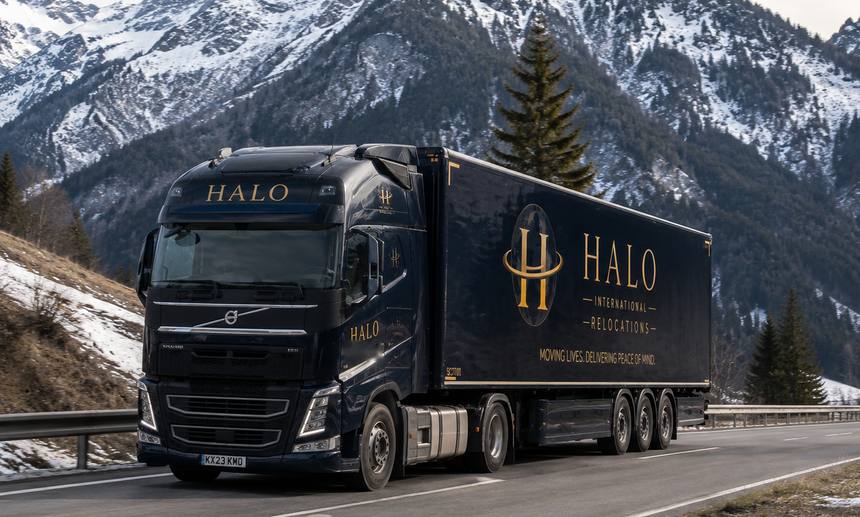
A Halo articulated lorry on an alpine pass, crossing Europe under snow-covered mountains
Southbound through the Alps. Long runs include mandatory driver rest — the tachograph decides the schedule, not the map.

Loaded at your door  ·  Across the Channel  ·  Unloaded at the other

Three ways to travel, and how to choose

Road freight is priced on the space you occupy in a vehicle and the distance it drives. Volume decides which of these makes sense.

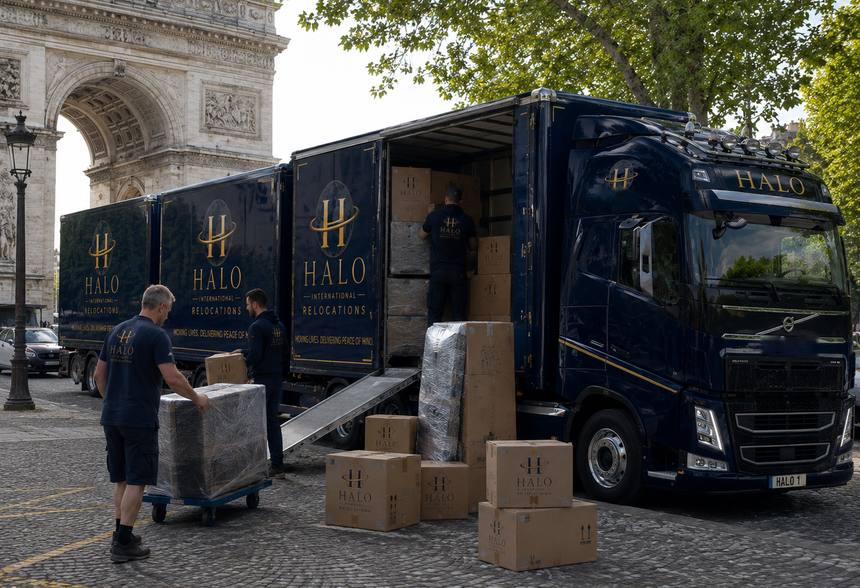
A Halo crew loading cartons and wrapped furniture into a lorry on a Paris street
A dedicated vehicle being loaded in Paris. Part loads share the same lorry with other consignments going the same way.

Dedicated vehicle

A full house · your load only

The vehicle carries nothing but your belongings and drives straight to your new address. Fastest, most flexible on dates, and the only option if you want loading and delivery on days you choose. Usually the right answer for a three-bedroom house or larger.

Part load

A flat or part of a house · shared vehicle

You pay for the metres you use and share the journey with other consignments going the same way. Considerably cheaper, and the reason our departures run weekly rather than on demand. The trade-off is a delivery window of a few days rather than a fixed date.

Small consignments

A few boxes or a single room

Students, second homes, a room of furniture for a relative. Too small for a removal vehicle to be worth booking, too large and too valuable for a parcel service. We consolidate these onto the scheduled runs.

Storage at either end

When the dates don't line up

European completion dates rarely match British ones. We hold goods in containerised storage in the UK, or with our partner at destination, and deliver when your keys actually exist.

How long it takes

Door to door, from UK collection to delivery at your European address. Dedicated vehicles are at the quick end; part loads wait for a scheduled departure.

DestinationPart loadDedicated vehicle
Northern France, Belgium, NetherlandsParis, Brussels, Amsterdam, Luxembourg4–8 days2–3 days
IrelandDublin, Cork, Galway4–8 days2–4 days
Germany, Denmark, Switzerland, AustriaBerlin, Munich, Zurich, Vienna, Copenhagen5–10 days3–5 days
Southern France, Spain, PortugalNice, Barcelona, Madrid, Lisbon, the Algarve6–12 days3–6 days
ItalyMilan, Rome, Tuscany, Puglia6–12 days4–6 days
Nordics and Central EuropeStockholm, Oslo, Warsaw, Prague, Budapest7–14 days4–7 days
Greece, Bulgaria, Romaniaand the far south-east10–18 days, and sometimes better by sea

Drivers' hours are regulated and tachographs are not negotiable, so a long run to southern Spain or Greece includes mandatory rest. Anyone promising Andalusia in two days is either using two drivers or misleading you. Customs clearance at the border is usually a matter of hours when the paperwork is right, and days when it is not.

What a Halo move to Europe includes

Quoted as one price, delivered as one service. Anything not on this list is named in your quotation rather than discovered later.

  • Pre-move survey by video call or in person, with a written volume assessment
  • Export-standard packing and materials, or cartons delivered if you're packing yourself
  • A numbered, valued inventory in the format European customs expect
  • Collection from any UK address, including Scotland, Wales and Northern Ireland
  • UK export declaration and EU import declaration, both prepared and filed
  • Your transfer of residence relief claim, with the documents each country requires
  • Ferry or Eurotunnel crossing and all road tolls, permits and vignettes
  • A sealed vehicle and secure overnight parking throughout the journey
  • Access assessment at destination, including parking permits and furniture lifts
  • Delivery into the rooms you choose, with furniture reassembled
  • Removal of packing debris on the day, and empty cartons collected later if you packed
  • One named consultant, contactable directly, from survey through to final delivery

Customs since Brexit, in plain terms

The relief is called transfer of residence, and it exists across the EU on broadly common terms. Meet them and your household goods enter free of duty and VAT. Miss one and you can be charged on the value of your own furniture.

What the relief actually requires

These conditions are set at EU level and applied by each member state, with local documents on top. We prepare the declarations and tell you exactly which certificates you need to obtain yourself, because several of them can only be issued to you in person.

  • Owned and used for six monthsYour goods must have been in your possession and use for at least six months before the move. Newly bought furniture is not covered and can be taxed.
  • Imported within twelve monthsThe relief runs from the date you establish residence. Leaving belongings in UK storage for two years and then shipping them will usually fail the test.
  • You must actually be movingEvidence of leaving the UK and registering at the destination: a rental contract or deeds, a local tax registration, sometimes a certificate from the consulate.
  • Not for sale for twelve monthsGoods admitted under the relief cannot be sold, lent or hired out for a year without telling customs and potentially paying the duty.
  • A full valued inventoryItemised and priced. "Box of kitchen items" is what turns a two-hour border crossing into a two-day one.
  • Moving to the UK is differentComing the other way you need HMRC's Transfer of Residence approval before the goods arrive. Apply as early as you can — in peak season the decision can take weeks, and without the approval number your load cannot clear.

Customs requirements differ by member state and change. We confirm the current position for your destination at survey and give you a written checklist before anything is packed.

What each country asks for

The relief is common; the paperwork is not. These are the documents that most often need obtaining by you rather than by us, and several take weeks.

France

Paris, Lyon, Provence, Dordogne

An itemised inventory in French, proof of your French address, and evidence you are leaving the UK. Expect a certificat de changement de résidence in some prefectures. Furniture lifts and street parking permits from the mairie are routine in cities.

Spain

Madrid, Barcelona, Valencia, Andalusia

The most document-heavy destination we serve. You will need an NIE number, padrón registration at your new town hall, and usually a baja consular or change of residence certificate. Start these before you leave, not after.

Portugal

Lisbon, Porto, the Algarve

A NIF tax number and a certificado de bagagem from the Portuguese consulate in the UK, obtained before the goods travel. The consulate appointment is the bottleneck, so book it early.

Italy

Milan, Rome, Tuscany, Puglia

A codice fiscale, proof of Italian residence and a declaration of transfer. Rural Tuscan and Umbrian access is the practical problem: single-track lanes and gateways that a full-size vehicle cannot enter.

Germany & Austria

Berlin, Munich, Vienna, Zurich

Registration at the local Anmeldung office and a customs declaration to the Zollamt, usually presented in person. Switzerland is outside the EU and has its own form and its own rules on alcohol and vehicles.

Ireland

Dublin, Cork, Galway

A PPS number and proof of transferring residence. Straightforward as European moves go, and the shortest crossing, but it is still a customs border and still needs the declarations.

Read our full road freight guides to France, Spain, Portugal, Italy, Germany, the Netherlands, Sweden and the Republic of Ireland. Not listed? We move to every EU member state plus Switzerland, Norway and the Balkans. Tell us the country and we will send the document list for it.

The last hundred metres

British streets were mostly built for vehicles. Much of continental Europe was not, and it is where road moves go wrong.

A furniture lift raised to a fourth-floor window on a Paris street, with a Halo lorry parked below
A monte-meubles working to a fourth floor in Paris. The street parking it occupies is permitted by the mairie, applied for days in advance.
  • A 40-tonne lorry cannot enter a medieval old townHistoric centres in Italy, Spain and southern France are frequently closed to heavy vehicles or physically too narrow. We shuttle the load in smaller vans, which takes longer and is priced in advance rather than discovered on the day.
  • Furniture lifts are normal, not exoticIn France a monte-meubles going up to a fourth-floor apartment window is standard practice, and it usually needs a street parking permit applied for at the mairie days beforehand.
  • Low emission zonesParis, Madrid, Brussels, Milan and dozens of other cities restrict older vehicles. Ours comply, but it affects routing and sometimes the vehicle we send.
  • Tell us about the lift and the stairsContinental lifts are often smaller than British ones, and spiral stone staircases are common. Both decide what will physically go up, and we would rather measure than guess.
SealedYour vehicle is sealed at loading and not opened in transit
Secure parkingOvernight stops at guarded compounds, never a lay-by
Same crewThe people who load in Britain unload at your new home
No portGoods are never containerised, craned or double-handled

When to do what

Working backwards from your moving date.

8 weeks out

Book the survey. Start any document that needs an appointment: consulate certificates, NIE numbers, tax registrations. These are the long poles.

4 weeks out

Confirm the quotation and the departure. Send us your destination address so we can check access and book any permit or furniture lift.

1 week out

We complete the valued inventory and both customs declarations. Set aside anything prohibited, and empty the fridge and the shed.

Loading day

We pack and load over one to two days. The vehicle is sealed and the seal number recorded on your paperwork.

Crossing and delivery

Tunnel or ferry, customs at the border, then straight to your address. We call you the day before with a delivery window.

Moving to Europe: common questions

What does a European move cost?

Volume first, then distance, then whether you need a dedicated vehicle or can share one. A one-bedroom part load to northern France and a four-bedroom dedicated vehicle to the Algarve are different by an order of magnitude. Use the volume estimator on our home page for a sense of scale, then let us survey and quote in writing.

Where are my belongings overnight?

In the vehicle, sealed, at a secure guarded compound. On a longer run the driver's mandatory rest is taken at a monitored truck stop, not a roadside lay-by. On a part load, goods may be consolidated at our depot before departure, where they are held in your own containerised storage rather than loose on a warehouse floor. We will tell you which applies to your move.

Can I send food, drink and alcohol?

Food is the one that surprises people. Since Brexit the EU prohibits personal imports of meat and dairy products from the UK, which includes the opened packets in your kitchen cupboards. Empty the fridge and the larder. Alcohol can travel but sits outside the transfer of residence relief, so it must be declared and duty is payable — a serious wine collection needs a decision and a budget, not a hopeful box.

How much notice do you need?

Three to four weeks is comfortable, and eight is better if documents like a Portuguese certificado de bagagem or a Spanish padrón are involved. Part loads run to a schedule, so a specific week matters more than a specific day. July and August are the busiest months on every European route.

Part load or dedicated vehicle?

Below roughly a two-bedroom flat, a part load is almost always cheaper and the extra few days rarely matter. Above a three-bedroom house, a dedicated vehicle usually costs little more once you account for the volume, and it buys you fixed dates at both ends. Between the two we will price both and show you the difference.

Do I need to be there for the delivery?

Someone does, to direct where things go and sign for the shipment. It does not have to be you — a friend, a relative or an agent with written authority works. What matters more is that the customs paperwork was correct before the vehicle left Britain.

Can you move my car at the same time?

Not inside the removal vehicle, but we arrange vehicle transport alongside the move. Registering a UK car in the EU means an import declaration, a certificate of conformity from the manufacturer, and a technical inspection, and the cost varies enormously by country. Ask before you assume it is worth bringing.

Do you move people back from Europe to the UK?

Constantly, and the return leg is often cheaper because vehicles are coming back anyway. You will need HMRC Transfer of Residence approval before your goods arrive in Britain. Apply early: in summer the decision can take several weeks, and the load cannot clear without the approval number.
Get a quotation for Europe

Tell us where you're heading and roughly when. A consultant will come back within one working day to arrange a survey.

European desk
07749 924755
Email
europe@halointernationalrelocations.com
Not sure of your volume?
Use the move estimator for an indicative figure in about thirty seconds, then send it through with your enquiry.
Going further?
See our guides to Australia, New Zealand, the USA, Canada, the UAE, South Africa, Singapore and Hong Kong, or read about air freight.
WhatsApp us